Google Web Hosting (2026): What Google Offers and What It Costs
Google does not sell a web hosting plan in the shared-hosting sense. What it offers is Google Cloud: Firebase Hosting for static sites, Cloud Run for containerised apps and Compute Engine for virtual servers, each billed by usage. A small static site can cost nothing on Firebase's free Spark plan, and one small always-on virtual server is free under Google's free tier, but a 2 GiB virtual server for WordPress starts around $12 a month for compute alone before disk, IP address and traffic (us-central1 prices, as of 18 Oct 2026).
Two older Google products confuse the search. Google Domains no longer exists as a Google business: Google agreed to sell all its registrations to Squarespace in June 2023, and the transfer closed on 7 September 2023. Google Sites is a site builder for simple pages, not hosting you control. Below are the three real hosting routes, what each costs at small-site traffic, and when a managed host on Google's infrastructure is the saner choice.
Google's three ways to host a website
| Product | Best for | Free allowance | Price after free |
|---|---|---|---|
| Firebase Hosting | Static sites, single-page apps | Spark: 10 GB stored, 360 MB/day transfer | Blaze: $0.026/GB stored, $0.15/GB transfer |
| Cloud Run | Containerised apps and APIs | 2M requests, 180,000 vCPU-s, 360,000 GiB-s a month | $0.000024/vCPU-s, $0.0000025/GiB-s, $0.40/M requests |
| Compute Engine | WordPress or any server you manage | 1 e2-micro VM, 30 GB disk, 1 GB egress a month | e2-small about $12.23/mo compute (730 h) |
Firebase Hosting is the closest thing to classic static hosting. Its free Spark plan needs no payment method and includes a custom domain with SSL and multiple sites per project. Cloud Run runs your code in a container and charges only while requests are being handled, rounded up to the nearest 100 milliseconds. Compute Engine is a plain virtual machine: you install the web server, PHP and database yourself, exactly as on any unmanaged VPS.
What a static site costs on Firebase Hosting
For a static site, the only meters that usually matter are storage and data transfer. Spark covers 10 GB of stored files and 360 MB of transfer a day; above that you need the pay-as-you-go Blaze plan, which keeps the same free amounts and then charges $0.15 per GB of transfer. The chart treats 360 MB a day as 10.8 GB over a 30-day month.
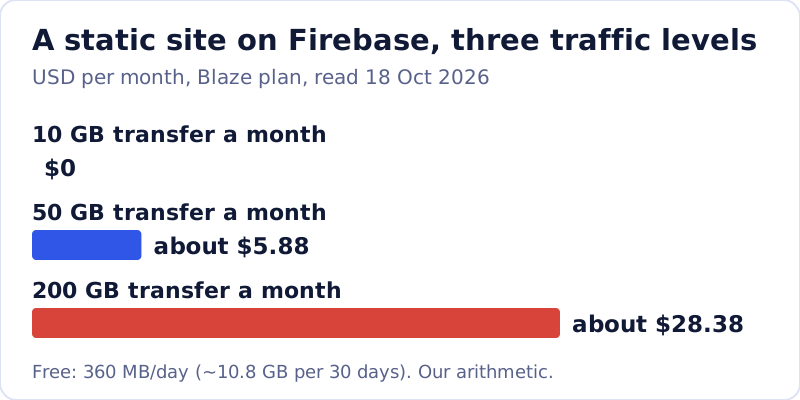
A portfolio or documentation site with a few thousand visitors a month is likely to stay inside the free amounts. A site serving 200 GB a month pays about $28 for transfer, more than many shared hosts charge, which is the usual trade with cloud storage: almost free at low volume, metered at high volume. A CDN-heavy static host may be cheaper at that point; our cloud pricing models guide explains why metered transfer behaves this way.
A small app on Cloud Run
Cloud Run suits a lightweight app or API better than a full VM. Take one service with 1 vCPU and 512 MiB of memory that handles 1 million requests a month at 200 milliseconds each. If the requests never overlap, that is 200,000 vCPU-seconds, of which 180,000 are free, leaving 20,000 at $0.000024, or about $0.48. Memory comes to 100,000 GiB-seconds and the requests to 1 million, both inside the free amounts. The bill is roughly 50 cents plus any outbound traffic above the free gigabyte; overlapping requests share billed instance time, so a busy service can cost less than this estimate.
What a WordPress server costs on Compute Engine
WordPress needs PHP and a database, so on Google it usually means a Compute Engine VM. Google's always-free allowance pays for one e2-micro virtual machine each month, provided it runs in Oregon (us-west1), Iowa (us-central1) or South Carolina (us-east1). It comes with 30 GB-months of standard persistent disk and a single gigabyte of outbound traffic from North American regions. An e2-micro has 1 GiB of memory, which is tight for WordPress with a database on the same machine.
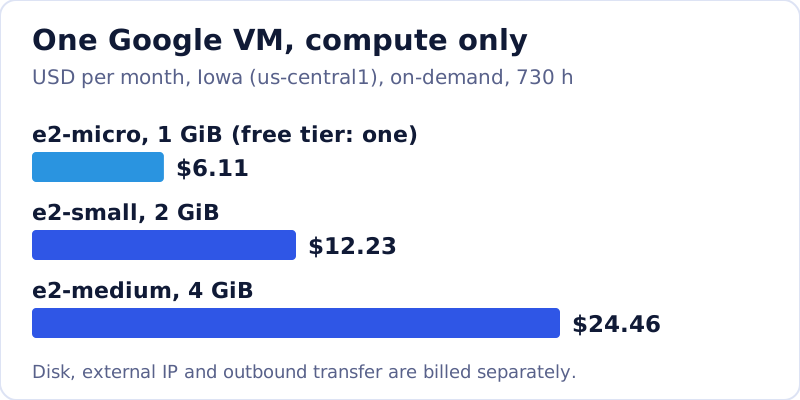
Moving up to an e2-small (2 GiB) costs about $12.23 a month and an e2-medium (4 GiB) about $24.46 for compute alone at Google's on-demand Iowa rate. Committed-use discounts lower that if you sign up for one or three years. You then add a persistent disk, an external IP address and outbound transfer, all billed separately, and you run updates, backups and security yourself. Our AWS website hosting cost breakdown shows the same pattern on Amazon's side.
The free trial, and how it ends
New Google Cloud customers get a $300 Welcome credit valid for 90 days, on top of the free tier. Google asks for a credit card or other payment method at sign-up, and eligibility excludes anyone who has already been a paying customer of Google Cloud, Google Maps Platform or Firebase. Leave the trial account unchanged past day 90, or spend the whole $300, and Google closes that billing account and stops everything running in its projects.
That last point catches people who build a real site during the trial. Google recommends upgrading during the trial to avoid losing service; upgrading keeps any unused credit. Set a budget alert in the billing console before you do, because a paid account is then billed for everything beyond the credit and the free tier.
When to use a managed host on Google's infrastructure instead
If you want Google's network without running a server, a managed cloud host is the middle path. Cloudways, for example, lists Google Compute Engine among the infrastructure providers you can pick, and handles the server setup, updates and backups for you. You pay more than for a raw VM, but you stop being the system administrator. Our comparison of managed cloud versus raw AWS and GCP puts numbers on that trade.
If that suits a WordPress site better than a self-run VM, you can see Cloudways' Google Cloud option, or start from our ranking of the best cloud hosting for managed alternatives at different budgets.
Edge cases
- The e2-micro free tier is measured by time, not by instance: running two e2-micros uses the month's free hours twice as fast.
- Cloud Run's free tier is aggregated across projects by billing account, so two small apps share one allowance.
- Regions change prices: every figure here is us-central1, and other regions cost more or less.
- Cloud Run rounds billable time up to the nearest 100 milliseconds, so many very short requests cost slightly more than their raw duration suggests.
- If you had a domain at Google Domains, it is now managed at Squarespace; Google points former users to Squarespace for help.
Google web hosting questions
Does Google offer web hosting?
Can I host a website on Google for free?
How much does Google Cloud hosting cost per month?
What happened to Google Domains?
Is Google Cloud good for WordPress?
Ready to choose a host? See the best managed cloud hosting, ranked, or start with what cloud hosting actually is.